Proteomic dynamics of bull sperm during post-testicular maturation
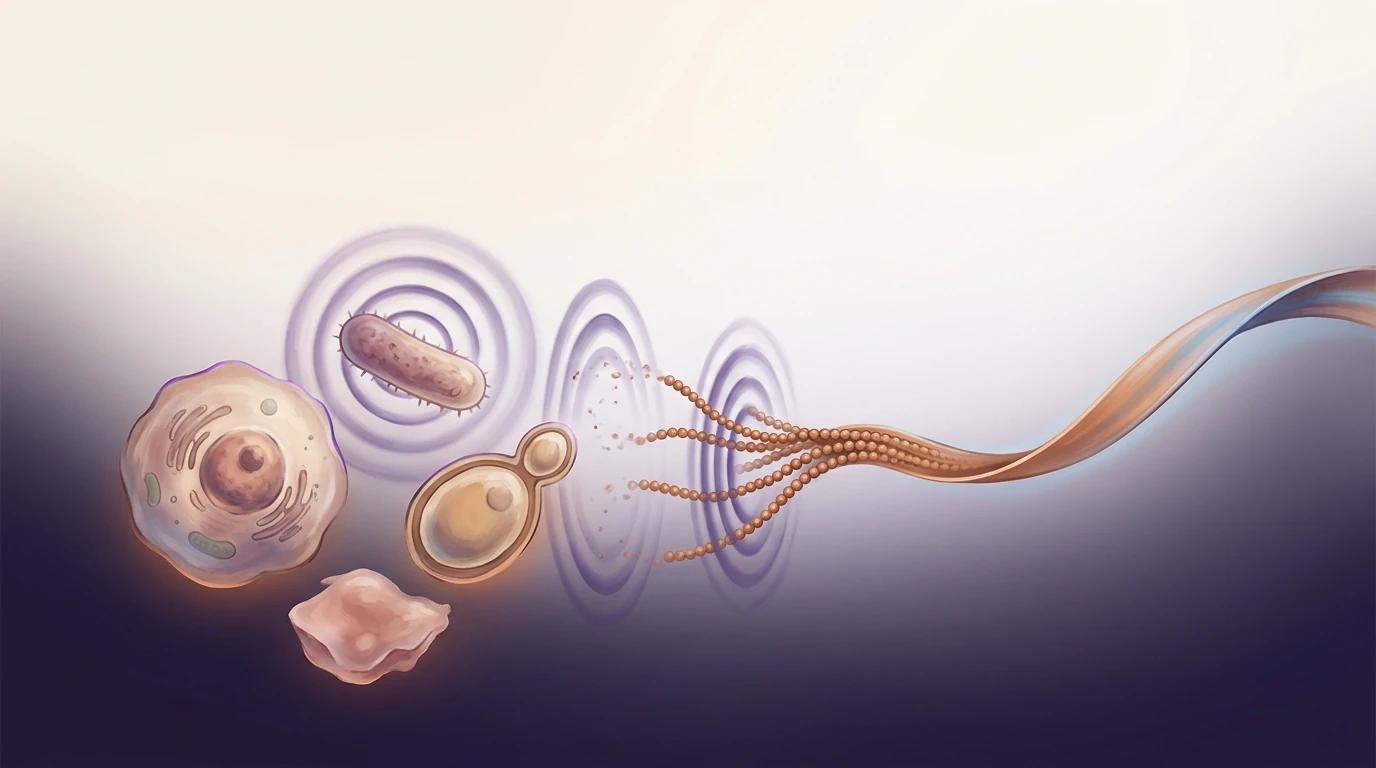
Mammalian sperm aren't fully ready to fertilize when they leave the testis — they mature as they travel through the epididymis, picking up some proteins and shedding others. Mapping that protein remodeling in a livestock species like cattle is central to understanding male fertility and improving reproductive technologies.
Leites and colleagues used shotgun proteomics to compare bull sperm recovered from the testis, the caput epididymis, and the cauda epididymis. Each of the three populations is biochemically distinct, with hundreds of proteins exclusive to each stage — surfacing candidate fertility markers and a conserved set of mammalian sperm proteins shared with ram, mouse, and pig.
Key findings
- Three biochemically distinct sperm populations resolved by DIA LC-MS/MS — 2,305 proteins in testicular, 2,554 in caput-epididymal, and 2,038 in cauda-epididymal bull sperm, with 702 / 483 / 314 proteins exclusive to each stage and 1,106 shared across all three. PCA cleanly separated the populations (PC1 = 52.6% of variance, PC2 = 28.9%).
- Fertility-relevant turnover quantified at log2FC greater than 6 — Cylicin-2 (log2FC +6.32), Cylicin-1 (+6.05), Acrosomal vesicle protein 1 (+5.74), and PAWP (+5.7) were sharply upregulated in mature sperm, while ILF2 (−8.44) and ILF3 (−8.06) were strongly cleared during epididymal transit.
- 264 sperm proteins conserved across bull, ram, mouse, and pig — a cross-species core enriched in motility (TEKT1/2/3, RSPH9, TSSK4, ROPN1L), energy metabolism (enolase 1/4, phosphoglycerate mutase, fumarate hydratase), and ubiquitin-proteasome quality control — defining a candidate panel of mammalian male-fertility proteins.
- A glycolysis-to-OXPHOS metabolic shift along the maturation path — testicular sperm were enriched in post-transcriptional regulation and glycolysis, caput sperm in integrin-mediated and protein-transport pathways, and cauda sperm in mitochondrial respiratory chain complex I assembly and oxidative phosphorylation.
PIXUL in the methods
"Samples were resuspended lysis buffer (10% SDS, 100 mM triethylammonium bicarbonate (TEAB). Lysates were sonicated (PIXUL® Multi-Sample Sonicator, Active Motif) for 20 min (Pulse 50 cycles, PRF 1 kHz, Burst Rate 20 Hz)."
— Leites et al., BMC Genomics (2026), Methods, Sample preparation for proteomic analysis
Why it matters for PIXUL users
If you run proteomics in reproductive biology, andrology, or livestock-fertility research, this paper is direct peer-reviewed evidence that PIXUL delivers consistency at scale on a notoriously demanding sample type. Bull sperm are heavily compacted, lipid-rich, and disulfide-crosslinked — exactly the kind of input where inconsistent lysis quietly collapses label-free quantification reproducibility across replicates. Here, a single PIXUL sonication step (20 min, 50-cycle pulse, 1 kHz PRF, 20 Hz burst) prepared three biologically distinct sperm populations from multiple animals reproducibly enough to quantify thousands of proteins per population and resolve log2FC shifts greater than 6 between maturation stages. For multi-application labs, this is the same multi-sample sonicator you would use for tissue proteomics, intracellular-protein extraction, and downstream multi-omic workflows — meaning your reproductive-biology pipeline, your tissue-proteomics pipeline, and your translational-discovery pipeline all share one front-end sample preparation platform, without proprietary consumables and without rebuilding protocols between sample types.