

- A proprietary consumable makes your sample-prep supply captive — one vendor sets the price, the lead time, and whether you can run at all when they're out of stock.
- A front end that runs on standard open-format plates keeps that supply uncaptive — the kind a liquid handler already uses, available from more than one vendor and reusable when a run is only partial.
- The value isn't unlimited choice — it's that the plate you standardize on is a standard one you can actually get (most labs settle on a SKU or two anyway, and that's fine).
A proprietary consumable is a single point of supply failure
When a sample-prep instrument only runs on its maker's proprietary plate or tube, the consumable becomes a quiet dependency on one supplier. That vendor sets the price, controls the lead time, and decides — through their stock levels — whether you can run this week. In a single lab that's an annoyance. In a shared core, where the front end sits upstream of every project, a consumable that's back-ordered doesn't stall one experiment; it stalls the whole queue.
That's the real cost of a captive consumable: it turns a routine supply item into a way for the entire facility to be stopped by a decision made somewhere else.
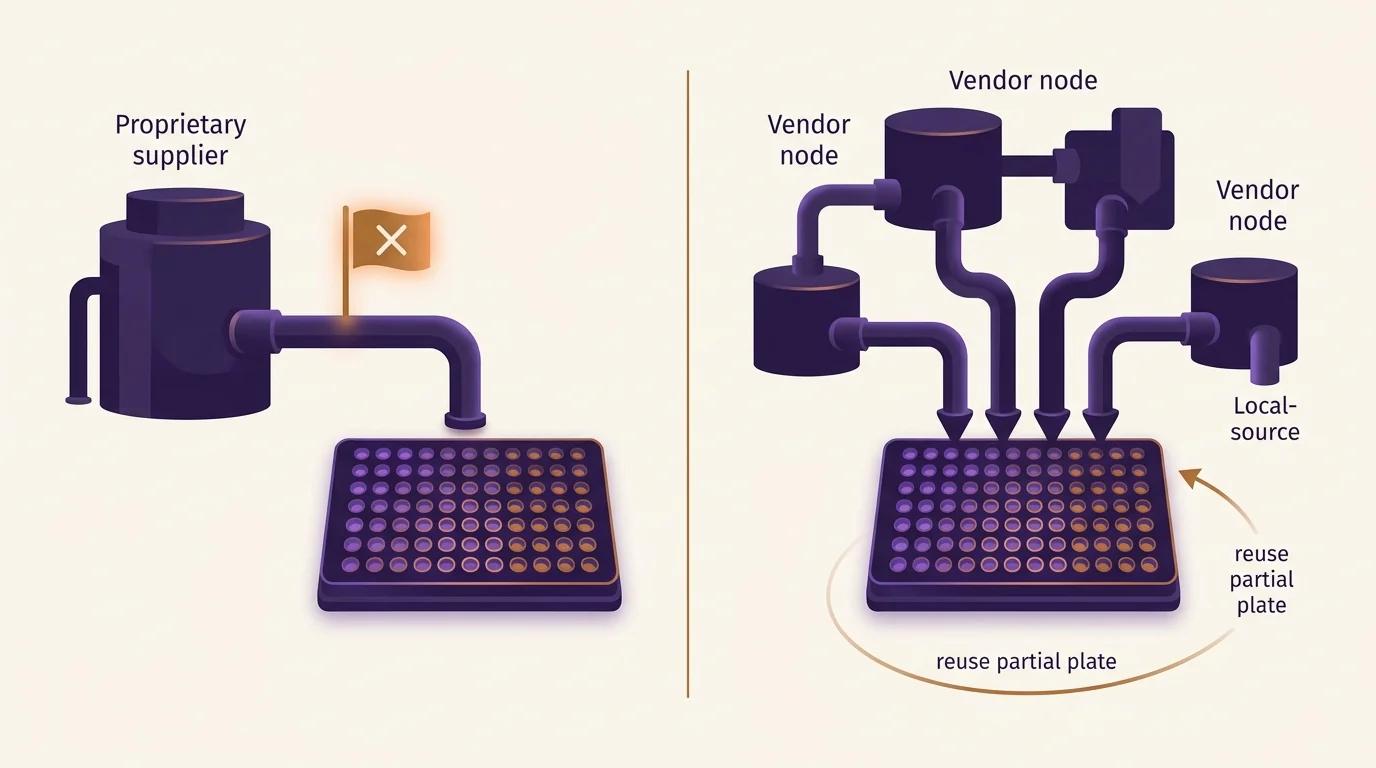
PIXUL runs on the standard plates your liquid handler already uses
PIXUL is built around standard open-format plates — the same kind your liquid handler and downstream steps already use — rather than a proprietary consumable. That means the plates come from more than one vendor, can be sourced locally rather than waiting on a single shipping pipeline, and a partly-used plate can be run again rather than discarded (the plate format your pipeline already runs on). The supply for your most upstream step looks like the rest of your lab's supply: ordinary, substitutable, and under your control.
The question isn't how many plate options you have — it's whether the one you use is captive.
What standard plates buy you — and what they don't
It's worth being honest about the limit of this, because the overclaim is tempting to make. Standard plates don't mean you'll shop endlessly or swap consumables every week — like most labs, you'll validate a plate or two and stick with them. That's normal, and it's fine.
What changes is what those one or two SKUs are. A standard open-format plate you can buy from several vendors, locally, and reuse when a run is partial is a fundamentally lower supply risk than a proprietary part only one company makes (why that supply control is part of staying up). You still standardize — you just standardize on something you can always get.
“We standardize on one plate anyway — does open-format matter?”
If we're only going to use one plate, does it matter whether it's standard or proprietary?
Yes — because the risk isn't in how many you use, it's in whether the one you use is captive. A standard SKU you can source from more than one supplier means a stockout or a price change at any single vendor doesn't stop your core; a proprietary one means it can. Same single plate on your bench, very different exposure behind it.
Check whether your front end's supply is standard or captive
Before you commit a core's most upstream step to an instrument, look past the instrument to its consumable: is the plate a standard open format you could buy from someone else tomorrow, or a proprietary part you can only get from the maker? (the full evaluation framework). For a facility that can't afford to have its front end stalled, that one question is worth asking out loud.
Run a demo on the standard plates you already stock — and confirm you can buy them from more than one source before you decide. Book a working demo →