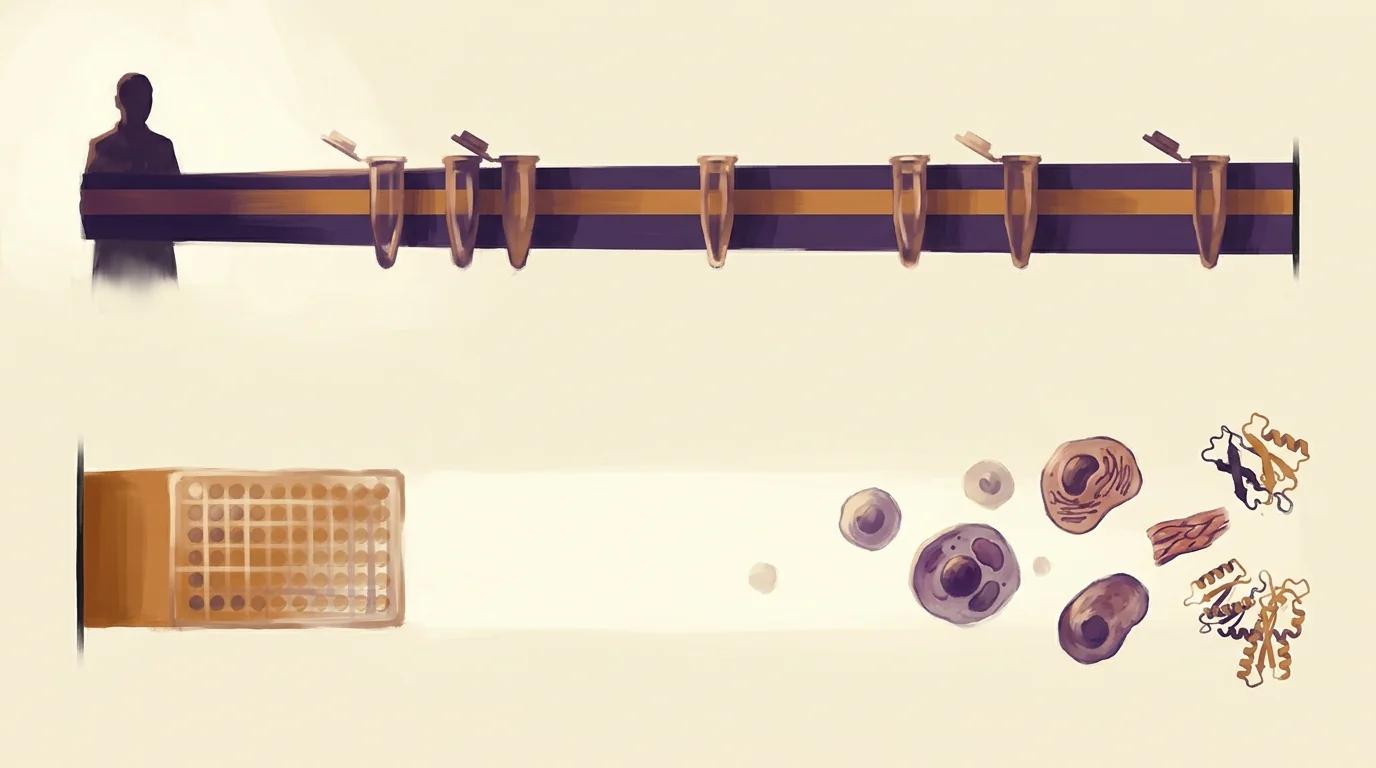
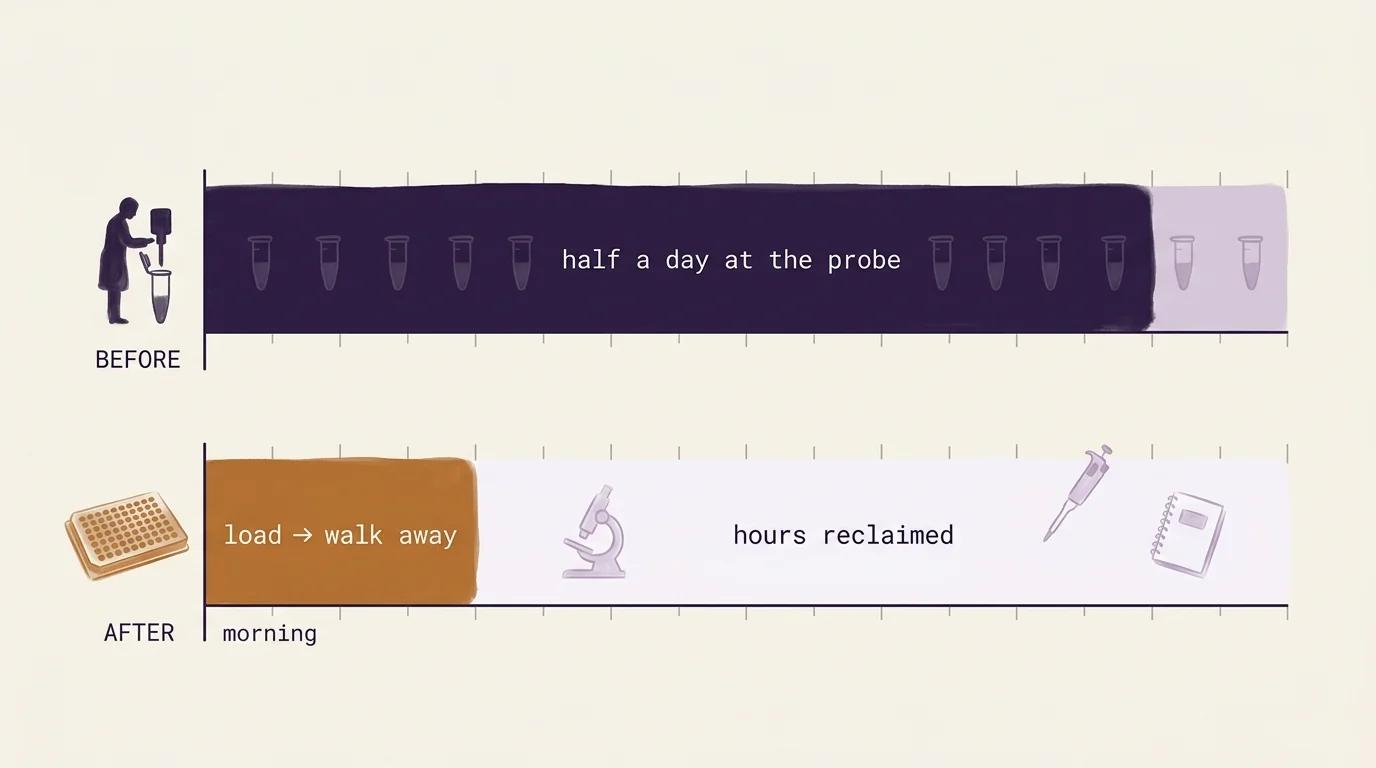
- The person who runs it gets their day back — a full plate goes in one hands-off run instead of a half-day spent one sample at a time at a probe.
- They keep it running themselves — the routine fluid and filter changes are a few minutes at the bench, not a service ticket and a wait.
- They trust what comes off the plate — the same result across all 96 wells, so they're not re-running samples to chase variability.
You can read every specification on a front-end instrument and still not know the thing that decides whether it gets used: what the person at the bench actually experiences when they run it. That's the question a core lead is really asking when they say “will my tech use it?” — and it's answered in the daily details, not the datasheet. Here's what changes for the operator.
The half-day at the probe is gone
Ask an operator who's moved off probe sonication what's different, and the first thing is time. The old way meant standing at a probe, one sample after another, for the better part of a morning — present for every tube, resetting between each. With PIXUL, a full 96-well plate goes in one hands-off run: load it, start it, and walk away (the throughput case in full). The same person who used to lose a half-day to the sonicator room gets it back for the work that actually needs them.
The person at the bench will tell you in a week what a spec sheet can't — whether they actually want to run it.
They keep it running without a ticket
The second change is who fixes it. On a service-dependent instrument, anything that needs attention means raising a ticket and waiting. Here, the routine upkeep — the fluid and the filters — is a few minutes the operator handles themselves, at the bench, without anyone scheduling a visit (in-house maintenance in practice). For the person responsible for keeping the instrument running, that's the difference between control and dependence.
They trust what comes off the plate
Third, they stop second-guessing the results. When disruption varies from well to well, the operator is the one who notices first — and the one who ends up re-running samples to be sure. A front end that delivers the same energy to every well of the plate gives a result they can trust the first time, across all 96 wells (the consistency case). Less re-work, more confidence in what they hand back.
The samples they used to dread now work
Fourth, the scary samples get less scary. Every operator has a sample type they brace for — the cell-wall organism, the dense tissue they're sure won't lyse. With adjustable energy and time, the material they expected to fail tends to come out, and that turns a dreaded run into a routine one. Confidence on the bench is its own kind of throughput.
Why the operator's verdict is the one to check
How do you know your tech will actually use it?
You ask them — and then you let them run it. A core lead can evaluate range, uptime, and cost on paper (the full evaluation framework), but the person at the bench is the one who lives with the instrument every day, and their verdict after a week of real runs is the adoption signal that matters most. An instrument the operator reaches for is one the whole core keeps using; one they avoid quietly becomes shelfware, however good its specs.